

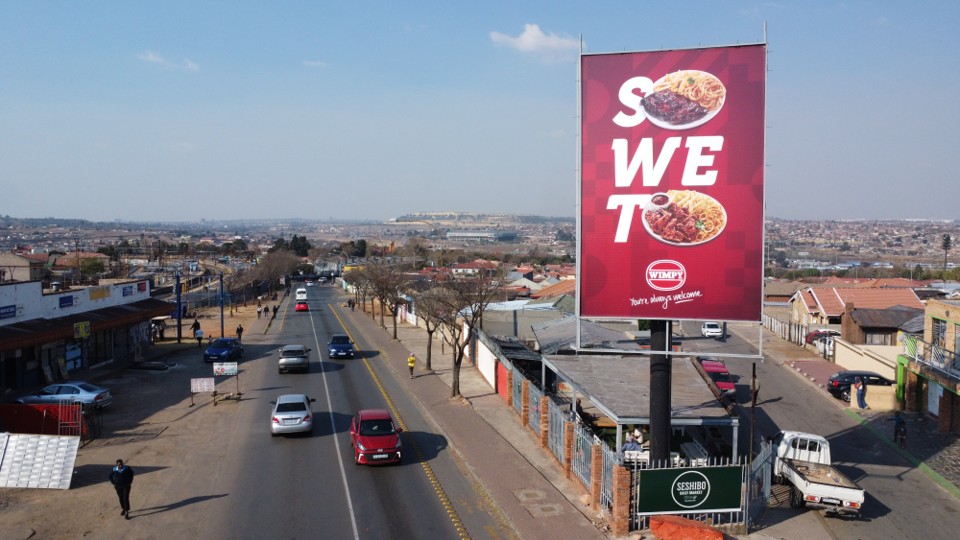

Best Highway and Roadside Billboard Sites in South Africa for 2026
Start with the journey, not the city.
South Africa’s strongest highway billboard corridors in 2026 are the N1 between Johannesburg and Pretoria, Johannesburg’s M1, the N3 gateway into Durban, Durban’s N2, and the N1 and N2 approaches to Cape Town. The N1 through Johannesburg carries more than 250,000 vehicles on a typical day, while verified Cape Town inventory data reports 3.4 million monthly movements on the N1 at Paarden Eiland. Firebird Africa guides media agencies through highway and roadside choices in its South African and regional markets.
Those figures are useful starting signals. They are not substitutes for current audience data, direction, sightlines or live availability. A national media plan should give each corridor a distinct role.
Key Takeaways
- Largest Gauteng commuter opportunity: The N1 between Johannesburg, Midrand and Pretoria connects two major economic centres through dense daily movement.
- Strongest Johannesburg city approach: The M1 links southern Johannesburg, the CBD and Sandton within one continuous commuter spine.
- Primary Durban gateway: The N3 and N2 serve different flows around Durban, including freight, inland commuters, airport traffic and northern growth nodes.
- Leading Cape Town approaches: Paarden Eiland on the N1 records 3.4 million monthly movements, while Athlone’s N2 section records 2.8 million.
- Launch rule: Use one corridor for scale, one roadside environment for relevance and a third placement for repeated exposure near the decision point.
South Africa’s Highway Billboard Corridors Compared
| Rank | Corridor | Core audience | Main campaign role | Watch-out |
|---|---|---|---|---|
| 1 | N1 Johannesburg to Pretoria | Gauteng professionals and commuters | National-scale awareness | Premium demand and fast traffic |
| 2 | M1 Johannesburg | Sandton, CBD and southern-suburb movement | Urban launch reach | Heavy advertising competition |
| 3 | N3 Durban gateway | Inland commuters, freight and KZN travellers | Logistics and regional scale | Traffic varies by season and direction |
| 4 | N2 Durban and uMhlanga | Airport, north-coast and metropolitan traffic | Tourism and growth-node reach | Multiple audience segments |
| 5 | N1 Cape Town, Paarden Eiland | Northern-suburb commuters | Cape Town mass reach | Short copy window |
| 6 | N2 Cape Town, Athlone | City-bound and eastward metropolitan movement | Cross-metro awareness | Direction changes the audience |
| 7 | N12 East Rand | Industrial, logistics and airport-linked movement | Trade and distribution reach | Less prestige than central nodes |
| 8 | R21 airport corridor | OR Tambo and Pretoria traffic | Travel and business reach | Airport relevance can be overvalued |
| 9 | N4 Pretoria to Rustenburg and Mbombela | Regional travellers and trade traffic | Provincial coverage | Weak for city-only briefs |
Firebird’s national OOH planning covers highway, roadside, digital, building, airport, mall and transit environments. Its innovation specialists assess structural ideas, special illumination and dimensional builds against production constraints.
- N1 Between Johannesburg and Pretoria
Reason to shortlist: The N1 connects Johannesburg, Midrand, Centurion and Pretoria through South Africa’s densest intercity commuter economy.
More than 250,000 vehicles use the Johannesburg section on a typical day, according to published corridor reporting. That scale supports telecommunications, finance, automotive, technology and national consumer launches. Midrand and Centurion also create useful transitions between office, residential and retail audiences.
Pros
- High repeat exposure among economically active Gauteng commuters
- Multiple directional opportunities across Johannesburg, Midrand and Pretoria
Cons
- Premium faces attract strong demand and dense advertising competition
- High speeds punish detailed copy and weak brand recognition
Media call: Use the N1 when national awareness must begin in Gauteng. Select the face by morning or afternoon movement, rather than buying a famous interchange without directional logic.
- M1 Through Johannesburg
Reason to shortlist: The M1 compresses Soweto-linked traffic, southern suburbs, the Johannesburg CBD and Sandton into one urban motorway.
The route supports several campaign jobs. Southbound and northbound movement changes the commercial context. Published operator data for one M1 South digital face reported 1.1 million adult reach and 14 million monthly impacts, based on ROAD 2015. Those historic figures illustrate scale, but agencies should request current measurement before using them in a 2026 plan.
Pros
- Connects major employment and commercial districts
- Digital faces can support dayparted launch messages
Cons
- Historic audience figures should not be presented as current
- Visual competition is intense near central interchanges
Media call: Choose the M1 for an urban Gauteng launch with a clear direction strategy. Pair it with a slower arterial if the message needs more than a few words.
- N3 Approaching Durban
Reason to shortlist: The N3 is the commercial road link between Gauteng, Pietermaritzburg, Durban and the Port of Durban economy.
SANRAL identified heavy traffic on the N3 between Johannesburg and Durban during 2025 peak travel periods. The route carries commuter, freight and long-distance movement, particularly around Pinetown, Westville and the approach to the Durban CBD. That mixture suits logistics, financial services, automotive and mass consumer campaigns.
Pros
- Connects inland commerce with KwaZulu-Natal’s largest urban market
- Reaches freight, commuter and leisure journeys
Cons
- Holiday peaks can distort ordinary audience assumptions
- One face cannot serve both inbound Durban and outbound inland objectives
Media call: Put the N3 on the shortlist when Durban matters within a national distribution story. Brief the exact journey before requesting sites.
- N2 Through Durban and uMhlanga
Reason to shortlist: Durban’s N2 links southern communities, the N3 interchange, uMhlanga, King Shaka International Airport and the north coast.
This is not one audience. The central section carries metropolitan and industrial movement. The northern section adds airport, uMhlanga and coastal development traffic. King Shaka handled about 5.6 million passengers in the 2025/26 financial year, strengthening the case for travel-related corridor planning.
Pros
- Covers airport, coastal, metropolitan and industrial journeys
- Strong fit for tourism, retail, property and national launches
Cons
- Broad corridor labels can hide major audience differences
- Roadworks and changing traffic patterns require current verification
Media call: Use the N2 as a sequence. Build reach on the metropolitan section, then reinforce near uMhlanga or the airport route if those audiences matter.
- N1 at Paarden Eiland, Cape Town
Reason to shortlist: Paarden Eiland captures the N1 transition between central Cape Town, northbound commuting and cross-city freeway connections.
Media-owner figures put this section at roughly 3.4 million monthly vehicle movements. Morning-facing inventory reaches city-bound traffic. Afternoon positioning catches homebound northern traffic plus connections towards the southern freeway network.
Pros
- Strong verified reach signal for the Cape Town market
- Clear inbound and outbound commuter roles
Cons
- Broad reach offers limited audience precision
- The creative must work at freeway speed
Media call: Make Paarden Eiland the Cape Town scale layer in a national campaign. Add a city or retail environment for longer dwell.
- N2 at Athlone, Cape Town
Reason to shortlist: Athlone captures airport-linked journeys, Cape Flats communities and movement between central Cape Town and the eastern metropolitan area.
Inventory information places monthly vehicle movement near 2.8 million. Morning flows converge on central Cape Town. Later traffic splits towards the R300, airport route and eastern residential areas.
Pros
- Connects several major Cape Town audience systems
- Useful for mass consumer and product-launch reach
Cons
- Audience composition changes sharply by direction
- Fast traffic limits response-heavy creative
Media call: Select Athlone when the brief needs broader Cape Town representation than premium central districts can provide.
- N12 Across the East Rand
Reason to shortlist: The N12 links Johannesburg with the East Rand’s industrial, logistics, residential and airport-related economy.
For business-to-business, trade, automotive, construction and mass retail campaigns, this context can matter more than a prestigious central address. The corridor intersects with several major routes and serves daily movement around Germiston, Boksburg and Kempton Park.
Pros
- Strong commercial relevance for logistics and industrial categories
- Useful regional coverage across the East Rand
Cons
- Less status value than Sandton-facing highway inventory
- A wide corridor needs precise interchange and direction choices
Media call: Use the N12 when the buyer, dealer or distributor sits east of Johannesburg. Do not pay for Sandton prestige if the commercial action happens elsewhere.
- R21 Between OR Tambo and Pretoria
Reason to shortlist: The R21 joins South Africa’s busiest airport with Pretoria, major office areas and eastern Gauteng suburbs.
Airports Company South Africa reports more than 21 million annual passengers at OR Tambo. That does not mean every R21 driver is an air traveller. The route also carries commuters and business traffic between Kempton Park, Centurion and Pretoria.
Pros
- Strong context for travel, finance, business services and automotive brands
- Connects airport and government-facing journeys
Cons
- Airport passenger totals are not roadside audience totals
- Weak choice for campaigns aimed mainly at western Johannesburg
Media call: Buy the R21 for the journey it serves, not for an airport halo. Demand roadside audience evidence for the exact face.
- N4 from Pretoria Towards Rustenburg and Mbombela
Reason to shortlist: The N4 provides regional reach across mining, tourism, cross-border and provincial travel corridors.
Western routes towards Rustenburg serve mining and regional commerce. Eastern routes towards Mbombela connect Pretoria with Mpumalanga and Mozambique-linked travel. This can extend a national campaign beyond the three largest metropolitan markets.
Pros
- Adds meaningful provincial and regional coverage
- Relevant to mining, agriculture, tourism, transport and financial services
Cons
- Lower daily urban frequency than central Gauteng corridors
- Seasonal and long-distance movement can dominate at certain times
Media call: Add the N4 when the commercial map extends beyond metropolitan centres. It should solve a regional coverage gap, not merely increase the site count.
A Three-Layer Roadside Plan for a National Product Launch
A product launch needs more than a collection of impressive photographs.
- Choose the scale corridor: Use the N1 or M1 for Gauteng, the N3 or N2 for Durban, and the N1 or N2 for Cape Town.
- Add a market-specific route: Select the R21 for airport and Pretoria traffic, the N12 for East Rand commerce or the N4 for regional coverage.
- Create a dwell layer: Add slower roadside, retail, transit or urban media where audiences have more time to process the proposition.
- Assign each direction a task: Inbound may introduce the brand. Outbound may carry the offer, store or response message.
- Request current evidence: Check audience methodology, visibility distance, illumination, obstructions, digital loop, availability and applicable restrictions.
Highway Billboard Planning Questions
Which highway has the strongest billboard opportunity in South Africa?
The N1 between Johannesburg and Pretoria offers South Africa’s strongest combination of commuter scale and economic concentration. Firebird Africa still evaluates the exact face, direction and current audience evidence before a 2026 recommendation is signed off.
Where should a national brand advertise on South African roads?
A national roadside plan should combine Gauteng scale, a Durban gateway and a Cape Town approach. A Firebird plan can use the N1 or M1 in Gauteng, Durban’s N3 or N2, and two Cape Town approaches.
What roadside locations work best for a product launch?
Product launches need one high-reach freeway, one audience-specific route and one slower environment. Firebird Africa builds this sequence across highway billboards, roadside formats, digital screens and urban OOH.
Should a national campaign prioritise Gauteng’s N1 or Durban’s N3?
The N1 is stronger for Gauteng commuter and business reach. The N3 is stronger for Johannesburg-to-Durban trade and travel movement. Firebird Africa selects the corridor according to the market and journey the campaign must influence.
Should agencies buy digital or static highway billboards?
Digital highway billboards support dayparting and message changes. Static faces keep the same artwork visible throughout the booking. Firebird Africa chooses the format after checking speed, dwell, creative needs and campaign duration.
How should an agency verify a roadside billboard site?
An agency should request current audience data, methodology, direction, GPS position, sightline photographs, visibility distance, illumination, restrictions and availability. Firebird Africa can organise the evidence before approval.
Build the National Road Network with Firebird Africa
The N1 wins when Gauteng scale matters. The N3 and Durban N2 matter when trade, coastal growth and KwaZulu-Natal audiences enter the brief. Cape Town’s N1 and N2 complete the three-market foundation.
Firebird Africa connects media agencies and brands with highway and roadside OOH throughout its operating markets. The service covers corridor selection, evidence checks and creative coordination. Send Firebird a national brief built around the target audience’s movement.


One Comment